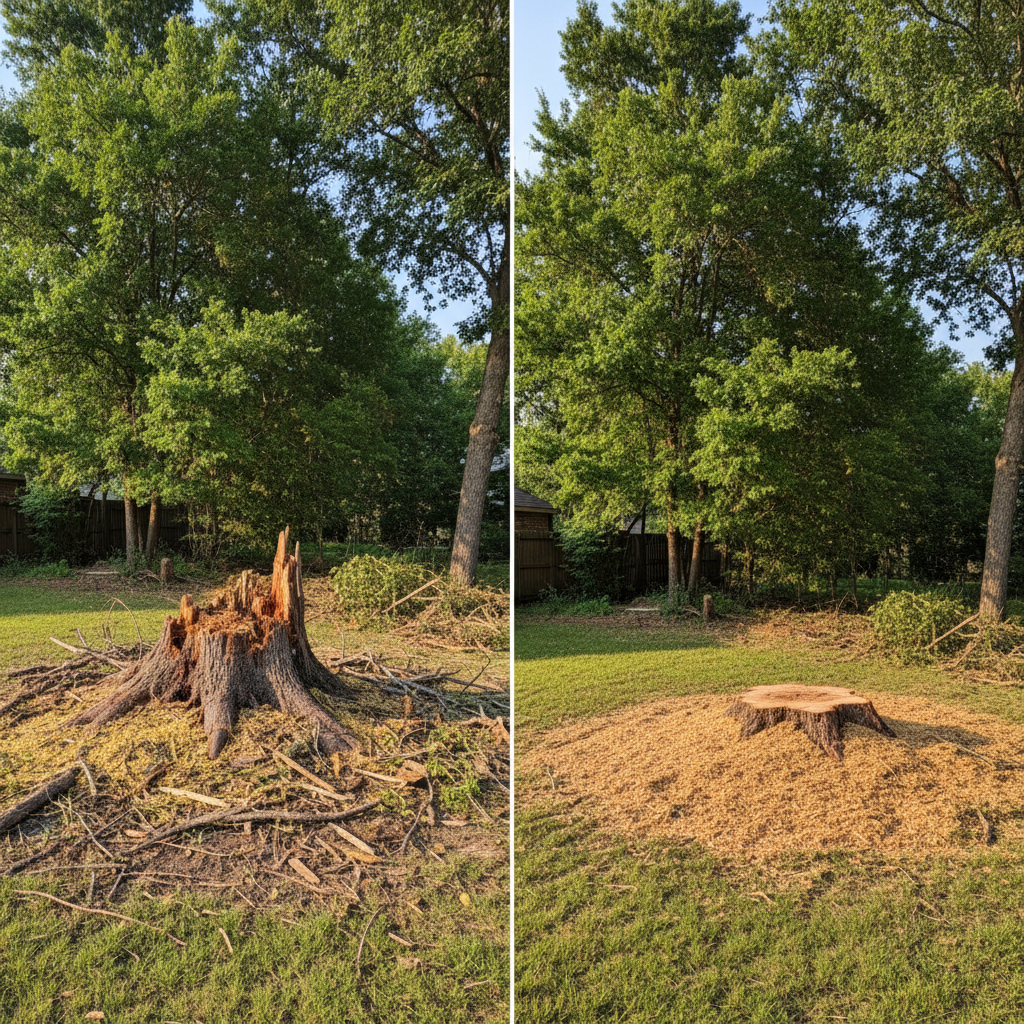
So, you've got a tree that needs to come down, or maybe it's already gone, and now you're staring at that stump. What's next? You've basically got two main paths: full stump removal or stump grinding. Folks around La Vernia ask me about this all the time, and there's a lot of confusion out there. Let's clear it up.
Stump Grinding: The Quick & Easy Fix
Stump grinding is what most people think of first, and for good reason. It's usually quicker and less invasive than full removal. When we grind a stump, we use a specialized machine with a rotating cutting wheel that grinds the stump down into wood chips. We typically go about 6-12 inches below grade, sometimes a bit more for larger stumps.
Here's what I like about grinding:
- Cost: It's almost always cheaper upfront than full removal. Less labor, less heavy equipment needed.
- Speed: A typical stump can be ground down in an hour or two, depending on its size and the type of wood.
- Less Disruption: The grinder mostly stays in one spot, so it's not tearing up your whole yard. You'll have a pile of wood chips, but that's about it.
- Appearance: Once it's ground down and you fill in the hole with soil, it's like the stump was never there. You can plant grass or even a small shrub over it.
But it's not perfect. The roots are still in the ground. For most trees, especially if they were healthy when cut, those roots will just decay naturally over time. That can take years, though. If you've got a tree that was diseased, like an oak with oak wilt, grinding might not be enough to prevent the disease from spreading through the root system to nearby healthy trees. That's a big deal here in La Vernia, especially with all the beautiful live oaks we have around town.
Another thing to consider is the wood chips. You'll get a fair amount. You can use 'em as mulch, or we can haul 'em away for you. Just know they'll be there.
Full Stump Removal: Getting to the Root of the Problem
Full stump removal means we're not just grinding the visible part; we're digging out the entire stump and as much of the major root system as possible. This is a much bigger job, and it involves more heavy equipment like excavators or backhoes.
Why would you go this route?
- Complete Eradication: No roots left to worry about. This is crucial if you're planning to build something where the stump was, like a new patio, a foundation, or even just a fence post. You don't want a decaying root system causing future settling issues.
- Disease Control: As I mentioned, if you're dealing with a diseased tree, especially something like oak wilt that spreads through root grafts, full removal is often the safest bet to protect your other trees.
- New Planting: If you want to plant another tree in the exact same spot, full removal clears out the old root ball, giving the new tree's roots a fresh start without competition or obstacles.
- No Regrowth: Some trees, like hackberry or mesquite, are notorious for sending up suckers from their root systems. Grinding won't stop that; full removal will.
The downsides are pretty clear too:
- Cost: It's significantly more expensive. More labor, more equipment, more time.
- Disruption: We're digging a big hole. Your yard will look like a construction site for a bit. There's a lot of soil disturbance, and you'll need to fill that hole with fresh soil.
- Time: It takes longer to complete, and then you've got the cleanup and restoration of your yard.
So, Which One Should You Choose?
For most homeowners in La Vernia who just want that stump gone and aren't planning major construction in that exact spot, stump grinding is usually the way to go. It's efficient, affordable, and gets rid of the eyesore without tearing up your whole yard. You can easily plant grass or put a flowerbed over the spot.
However, if any of these apply to you, you should seriously consider full stump removal:
- The tree was diseased, especially with something like oak wilt.
- You're planning to build a structure, pour concrete, or install a new foundation where the stump is.
- You want to plant a new, large tree in the exact same spot.
- The tree was known for aggressive root suckering (like a mesquite).
Ultimately, it comes down to your specific needs and what you're planning for that area of your property. Don't just assume grinding is always enough. Give me a call at Allgreen Tree, and I can come out, take a look at your situation, and give you an honest recommendation based on the tree type, its health, and your plans. We've seen it all around here, from the sandy loam near the river to the heavier clay soils further out, and we know what works best for our local conditions.